
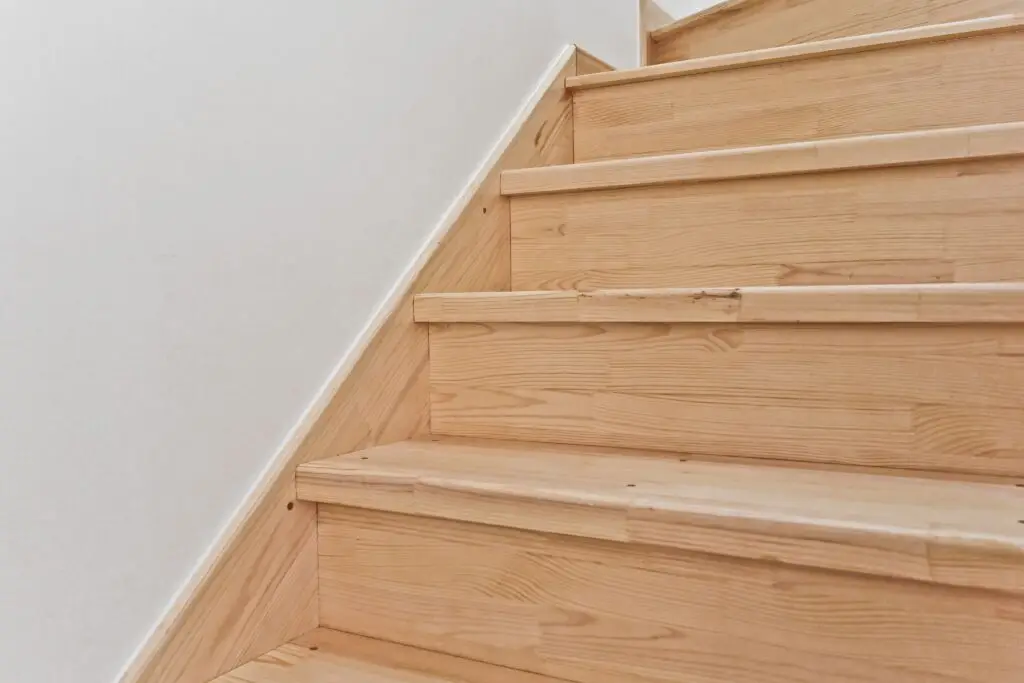
Converting a staircase to hardwood is one of the most impactful home improvement projects you can undertake. While it requires patience and precision, following a professional workflow ensures a squeak-free, high-end result that meets local building codes.
Quick Answer: Stair Hardwood Installation Requires Precise Cuts, Secure Adhesion, and Proper Nosing
Success lies in the details. Unlike floor planks that can “float,” stair components must be fully bonded to the sub-stair using high-grade construction adhesive. Every cut must be square to prevent gaps, and the “nosing” (the front edge) must be flush to ensure a safe, trip-free surface.
Tools and Materials Needed
To achieve a professional finish, gather the following before you begin:
- Stair Treads and Risers: Solid wood treads (horizontal) and risers (vertical).
- Construction Adhesive: High-tack polyurethane adhesive (e.g., Liquid Nails or Loctite PL Premium).
- Finishing Nails: 2-inch 16-gauge or 18-gauge brad nails.
- Stair Nosing: Essential if you are using flooring planks instead of solid treads.
- Measuring and Cutting Tools: * Stair Tread Template Tool: Highly recommended for capturing out-of-square angles.
- Miter Saw: For clean cross-cuts.
- Table Saw: For ripping treads and risers to the correct width/height.
- Jigsaw: For cutting around any decorative trim or “notching.”
Step-by-Step Installation Process
1. Remove Existing Covering
Strip the stairs down to the raw wood sub-treads. This usually involves removing carpet, tack strips, and staples. If the existing sub-tread has a rounded “overhang” (nosing), you must saw it off flush with the riser so the new hardwood riser can sit flat against the frame.
2. Measure and Cut Treads
Stairs are rarely perfectly square. Use a Stair Tread Template Tool to measure the exact width and angle of each step. Transfer these measurements to your hardwood tread and cut using a miter saw. Dry-fit every piece before applying any glue.
3. Install Risers
Start from the bottom of the staircase and work your way up. Apply a “bead” of construction adhesive in a zigzag pattern on the back of the riser, press it firmly against the frame, and secure it with a few finishing nails near the top and bottom edges.
4. Secure Stair Nosing & Treads
Apply a generous amount of construction adhesive to the sub-tread. If using a solid tread, slide it into place so it sits tightly against the riser above it. If using flooring planks, install the planks first and then install the Stair Nosing on the front edge. The nosing is the highest-stress point, so ensure it is both glued and nailed securely.
5. Fill Nail Holes and Finish
Use a color-matched wood filler to hide any nail heads. If you installed unfinished wood, sand lightly with 120-grit sandpaper, tack cloth the dust away, and apply your choice of stain and polyurethane. For pre-finished wood, use a matching touch-up pen for the cut edges.
Common Mistakes to Avoid
- Incorrect Measurements: Even a 1/16th-inch gap can be visible. Always “measure twice, cut once.”
- Skipping Adhesive: Relying only on nails will lead to wood-on-wood friction, causing the stairs to squeak every time someone steps on them.
- Uneven Riser Height: Building codes in FL and GA are strict—the height of each step must be consistent within 3/8 of an inch. Ensure your new materials don’t create a “trip hazard” at the top or bottom landing.
Hardwood Stair Installation Cost in FL
In the Southeast market (Florida), costs vary based on the wood species and the complexity of the staircase (straight vs. curved).
- Labor Only: $100 – $200 per step.
- Materials (Oak/Hickory): $50 – $150 per step.
- Total Project Average: For a standard 13-step staircase, homeowners in FL/GA should budget between $2,200 and $4,500 for a full professional conversion.
FAQs
Should stair treads match flooring?
Ideally, yes. In open-concept homes common in the South, matching the stairs to the main floor creates a seamless flow. However, some designers choose a darker stain for the treads to make the staircase an architectural focal point.
Are hardwood stairs slippery?
They can be. To improve safety, we recommend a satin or matte finish, which offers more natural “grip” than a high-gloss finish. You can also add clear anti-slip additives to the final coat of sealant.
Can you install hardwood over existing stairs?
Yes, this is called a retrofit. Special “thin-profile” treads are designed to fit over existing plywood or pine stairs without significantly altering the height of the steps.
Professional Stair Installation Services
Staircases are the most technically demanding part of any flooring project. At Santos Brothers Flooring, we serve residential clients throughout Florida and Georgia, ensuring every tread is level, every cut is tight, and every step is safe.
Ready to upgrade your home? Contact Santos Brothers Flooring today for a free consultation and professional estimate.