
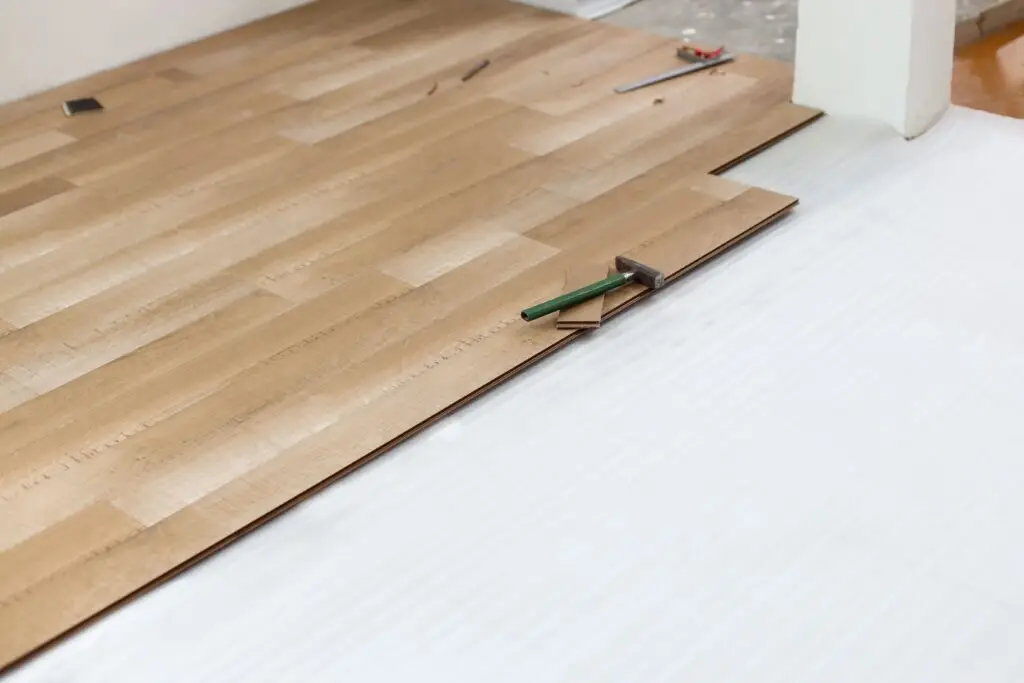
Installing solid hardwood is a specialized trade that requires precision, specialized pneumatic tools, and a deep understanding of wood science. Unlike “floating” floors like laminate or luxury vinyl plank (LVP), solid hardwood becomes a permanent part of your home’s structure.
Quick Answer: Solid Hardwood Must Be Nailed or Stapled to a Wood Subfloor
Solid hardwood flooring cannot be “floated” or simply glued down in most residential applications. To ensure stability and prevent the wood from shifting or warping, 3/4-inch solid planks must be mechanically fastened—using cleats or staples—to a wood-based subfloor (typically CDX plywood or OSB). This creates a rigid, long-lasting surface that can withstand decades of foot traffic.
Subfloor Requirements
The foundation of your floor determines its lifespan. For a successful solid hardwood installation in the US, the subfloor must meet three strict criteria:
- Material: Minimum 5/8″ (preferably 3/4″) CDX plywood or 23/32″ OSB (Oriented Strand Board).
- Levelness: The surface must be flat within 3/16″ over a 10-foot radius. High spots must be sanded down, and low spots filled with approved leveling compounds.
- Moisture Content: The subfloor must be dry. In the US, the moisture differential between the subfloor and the hardwood planks should not exceed 2% to 4% (depending on plank width).
Installation Process Overview
Acclimation
This is the most critical step. Because wood is an organic material, it expands or contracts based on your home’s humidity. Solid hardwood must sit inside the room where it will be installed for at least 5 to 7 days with the HVAC system running at normal living conditions. This prevents the wood from shrinking or buckling after it is nailed down.
Layout
Installers snap chalk lines to ensure the first row is perfectly straight. In most US homes, hardwood is installed perpendicular to the floor joists for maximum structural strength. A vapor retarder (like 15lb asphalt felt or “aquabar” paper) is laid down between the subfloor and the hardwood to minimize moisture transfer.
Fastening
Using a pneumatic flooring nailer or stapler, the installer drives fasteners through the “tongue” of the board at a 45-degree angle. This “blind nailing” technique hides the fasteners so that only the beautiful wood surface is visible. Fasteners are typically spaced every 6 to 10 inches.
Sanding and Finishing (if unfinished)
If you choose “site-finished” wood, the floor must be sanded with progressively finer grits of sandpaper after installation. Once smooth, a stain is applied, followed by 2 to 3 coats of protective polyurethane (either water-based or oil-based).
Common Installation Problems
- Crowding/Buckling: If the wood is installed too tight against walls without an expansion gap, it will lift off the subfloor when humidity rises.
- Squeaking: Often caused by an uneven subfloor or using the wrong type of fastener, leading to friction between boards.
- Gapping: Occurs if the wood was not properly acclimated or if the home’s humidity drops significantly in the winter without a humidifier.
FAQs
Can solid hardwood be installed over concrete?
Generally, no. Solid hardwood requires a wood subfloor for nailing. If your home has a concrete slab (common in many modern US builds), you must first install a plywood “sleeper” system or choose engineered hardwood, which is designed specifically for glue-down installation on concrete.
How long does installation take?
For a standard 1,000-square-foot project:
- Pre-finished wood: 2 to 3 days.
- Site-finished wood: 5 to 7 days (to allow for sanding, staining, and drying time).
Does it require expansion gaps?
Yes. A gap of approximately 1/2″ to 3/4″ must be left around the entire perimeter of the room. This gap is later covered by baseboards or quarter-round molding, allowing the floor to expand naturally during humid months.
Professional Hardwood Installation Services
A solid hardwood floor is a lifetime investment. DIY errors in acclimation or fastening can lead to costly repairs and ruined materials. Our professional installation team ensures your project meets the National Wood Flooring Association (NWFA) standards, giving you peace of mind and a flawless finish.
Schedule Your Professional Installation with Santos Brothers Flooring Today!